MathGov Home

MathGov — The Historical Foundation and Evolving Ethical Framework
2006–2026 · Origin, theory, and evolution

MathGov is the historical foundation
for ripple-aware governance

It began as a long search for a decision framework that could account for the full stakeholder field, enforce rights as a hard floor, and optimize across nested unions of life rather than sacrificing one layer to feed another.

∿∿∿
Overview

A framework for decisions that do not hide their real costs

Most systems optimize for one thing — profit, votes, power, speed, convenience. The cost is usually pushed outward, onto a household, a community, a future generation, or the biosphere. MathGov was built to make those hidden costs visible and governable.

The core premise is simple: every being and institution exists inside overlapping unions. A decision that looks good at one level but harms the containing unions is not truly optimal. It is deferred damage. MathGov therefore asks decision-makers to evaluate actions across the full stakeholder set, not only the nearest beneficiary.

The one-sentence version: MathGov is a union-based ethical and governance framework that evaluates decisions across nested stakeholders, welfare dimensions, rights constraints, and long-horizon ripple effects so that optimization no longer depends on robbing one union to reward another.

Origin

Where this started

The deepest roots of MathGov go back to a University of Colorado honors thesis written from 2006 to 2010 on the unsustainability of future war for humanity and the biosphere. The central pressure never disappeared: how do we make decisions that do not destroy the conditions of life while claiming to defend it?
Read the original 2010 honors thesis

In January 2023, that pressure found a new developmental path. The project re-entered public form through writing, iterative system design, and sustained AI-assisted synthesis. What began as the early “Mathematical Union Frame” rapidly evolved into a broader and more rigorous architecture: MathGov, an attempt to formalize ripple-aware decision-making across unions, rights, welfare, and time.

From the beginning, the intent was not to create a slogan or ideology. It was to build a framework that could be criticized, refined, tested, clarified, and eventually implemented.

Foundational principles

What the early system got right

The architecture deepened over time, but several principles were present from the beginning and remain central to the MathGov lineage.

Unions matter

No entity exists in meaningful isolation. Every individual is nested within larger layers of interdependence. Decisions must be evaluated across those unions, not only at the point of immediate gain.

Evidence over dogma

Good intentions and political narratives are not enough. Decisions should be assessed through measurable impacts, tested assumptions, and explicit reasoning across the stakeholder field.

Win-win as the goal

Optimization means seeking the strongest feasible expansion across unions while minimizing harm. A “win” built on silent losses elsewhere is not a true success.

Long-term by design

Short-term solutions that extract from future generations or from the biosphere are structurally unsound. Sustainability is part of the logic, not a decorative value.

Rights are non-negotiable

Fundamental rights cannot be casually traded away for aggregate benefit. This eventually became formalized as a hard gate, not a soft preference.

Evolution timeline

Three years of building in public

MathGov did not arrive fully formed. Each version responded to a real comprehension failure, a new empirical pressure, or a structural gap revealed through use. What emerged over time was not just a theory, but a growing ethical and operational framework for optimizing decisions across nested unions of life.

2023

Foundation and first public frame

The project took clearer public form with greater scientific rigor. The union hierarchy was introduced, the core premise established that decisions can be evaluated across a full stakeholder set, and a wide range of early writings were published on MathGov.org, including Core Principles of MathGov, Optimizing Decision-Making, MathGov as the Optimal Reality Navigator, Sustainable Capitalism, Advancing Civilizational Resilience, Harmonizing Individual and Collective Flourishing, Alignment and AI, MathGov Tools & Areas of Application, View of the Social Sapiens, and Diving Deep into Infinity.

2024

Structural formalization

MathGov entered a more explicit developmental phase. Articles began appearing on X.com. The first scientific paper on Union-Based Ethics was published. The first full book, MathGov: Alignment in the Age of AI, was published on MathGov.org. During this phase the Sentience Gradient Protocol developed out of Union-Based Ethics, evidence gathering for Union-Based Reality accelerated, and the framework began shifting from broad conceptual framing toward a more formal and testable ethical architecture.

2025

Expansion and architecture

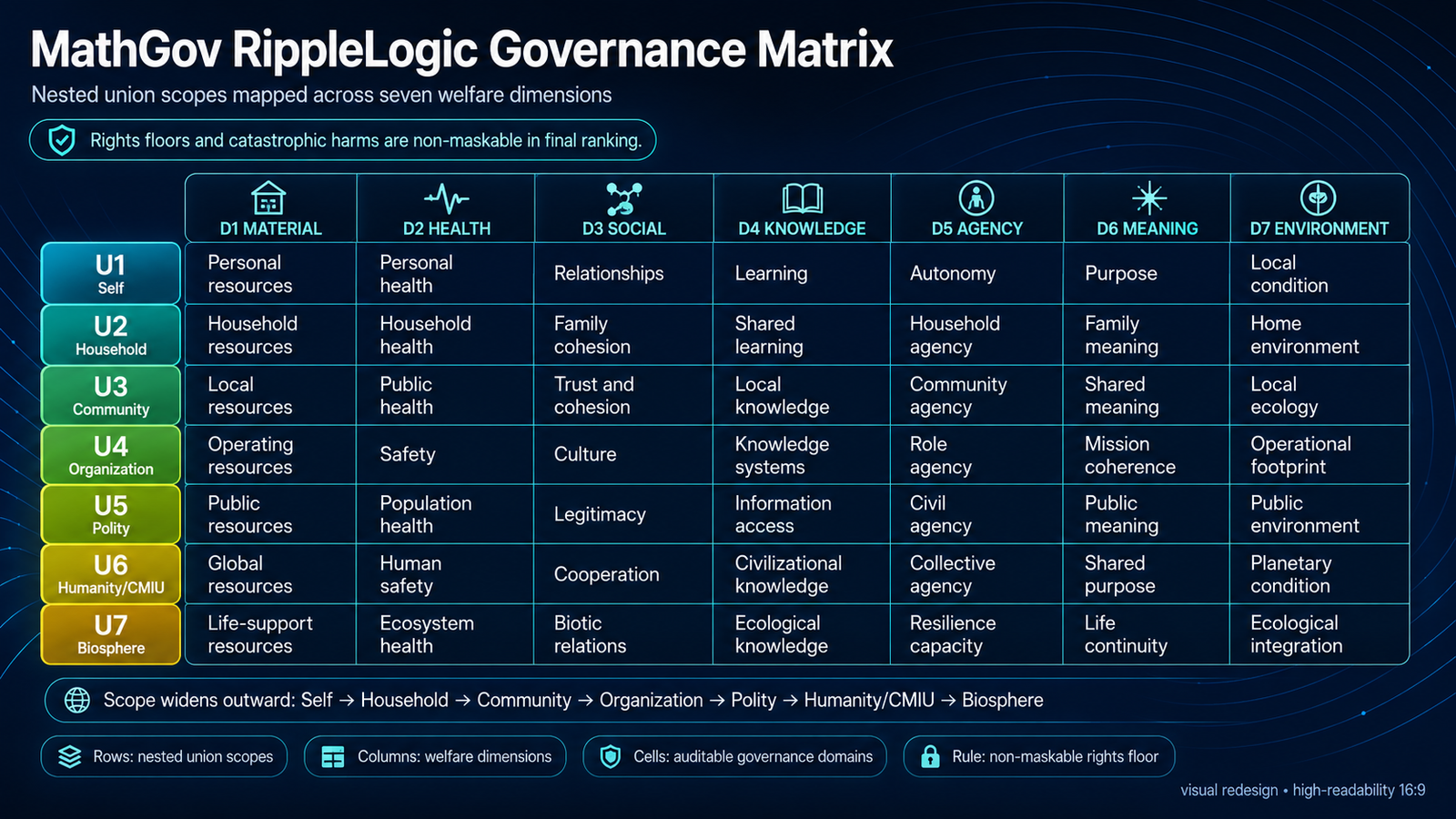
Key components locked into place. The Non-Compensatory Rights Constraint (NCRC) became a hard gate, meaning rights could not be overridden by compensatory benefit claims. Seven welfare dimensions were formalized: Material, Health, Social, Knowledge, Agency, Meaning, and Environment. The Union Coherence Index (UCI), Hollowing-Out Index (HOI), life-coherence structures, the MathGov Immune System, and broader resilience and failure-detection logic were integrated. The Foundation Paper and core files matured the system into a disciplined architecture rather than a loose conceptual framework.

2025–26

Transition to implementation

A decisive distinction emerged. MathGov became increasingly clarified as the broader ethical and civilizational framework, while RippleLogic emerged as the active decision engine and implementation layer. The Triangle Model helped resolve comprehension failures around union scopes. NCAR — Notice, Choose, Act, Reflect — locked in as the learning loop. The RL_Teacher specification appeared, and ripplelogic.org launched as the operational home for live implementation.

2026

System execution and release discipline

The work entered a more mature operational phase built around versioned releases, reproducible artifacts, and canonical system discipline. By early 2026, RippleLogic releases such as v7.4.5, v8.1, v8.5.3, v8.6, and v9.0 marked the shift from evolving architecture into structured execution.

Phase progression
1. Vision2. Framework3. Formalization4. Architecture5. Execution6. System discipline
Framework today

The union stack and welfare dimensions

MathGov evaluates decisions across nested unions of consequence. In current practical framing, the operational stack runs from Self through Biosphere, with later horizons held as wider ethical reminders. Each union is examined across seven welfare dimensions: Material, Health, Social, Knowledge, Agency, Meaning, and Environment.

SelfThe individual as a full stakeholder, evaluated across all seven welfare dimensions.
HouseholdThe intimate and family-level union where immediate support, care, and mutual dependence are concentrated.
CommunityLocal relational and civic networks, shared services, neighborhoods, and nearby social ecosystems.
OrganizationInstitutions, companies, schools, agencies, and coordinated groups where large-scale decisions often originate.
PolityThe formal political union, including city, region, and nation-scale governance and public rules.
Humanity / CMIUThe broader human collective, including cross-border impacts and future-generation implications within the Collective Managing Intelligence Union framing.
BiosphereThe living system all other unions depend on. Every serious governance framework must treat it as a standing stakeholder, not an afterthought.
How it works

The NCAR loop

MathGov is not a one-time static score. It is a learning process. NCAR is the practical loop that moves decision-making from vague instinct toward explicit, ripple-aware reflection and revision.

N
Notice

See the situation clearly, including which unions are affected, what assumptions are being made, and which welfare dimensions are in play.

C
Choose

Compare the options against rights, unions, ripple effects, and long-horizon consequences rather than only short-term gain.

A
Act

Implement the best coherent option with clarity about what is being optimized and what is not being sacrificed.

R
Reflect

Measure what actually rippled, learn from real outcomes, and use that feedback to improve future decisions.

MathGov → RippleLogic

From theory to implementation

MathGov is the wider ethical and civilizational framework. RippleLogic is the active reasoning and implementation layer built on that foundation.

Theory

MathGov

The historical foundation, ethical architecture, and public record. This is where the union-based worldview, rights logic, welfare structure, and long-horizon governance logic were first articulated and refined.

The function of MathGov is to clarify the deeper operating principles: what counts as a stakeholder, how ripple effects should be evaluated, why rights must remain non-compensatory, and how flourishing should be understood across nested unions.

Implementation

RippleLogic

The live decision engine and operational home. This is where the framework moves into release discipline, agent systems, calculable structures, templates, and practical deployment.

MathGov provides the ethical architecture. RippleLogic carries forward the active implementation, tooling, and structured decision logic.

Visit RippleLogic.org ↗

Who it serves

Three entry points into the system

Individuals

Daily life and household choices

MathGov can be used to think more clearly about choices that affect health, family, resources, meaning, and local ripple effects. Governance begins with lived decisions, not only with institutions.

Organizations

Strategic and institutional alignment

Organizations can use the union stack to see where internal optimization is generating hidden externalized costs, and redesign decisions before those costs return as conflict, fragility, or distrust.

Researchers

A framework meant to be scrutinized

MathGov is designed to become increasingly testable. Union scope can be specified. Welfare dimensions can be measured. Rights constraints can be made explicit. The framework is meant to improve under pressure.

Historical archive

The long record matters

MathGov is not just a final theory. Its evolution is part of the evidence. The archive shows how the framework responded to pressure, complexity, critique, and implementation demands over time.

2006–10
University of Colorado honors thesis on the unsustainability of future war for humanity and the biosphere
Origin
2013–15
Master’s work on Multi-Faceted Sustainable Enterprises, extending the search for system-level sustainable design
Research
2023
Public relaunch through the Mathematical Union Frame and early MathGov essays on governance, sustainability, AI, flourishing, and interdependence
Foundation
2024
MathGov: Alignment in the Age of AI, Union-Based Ethics paper, and early Sentience Gradient development
Publication
2025
NCRC, welfare dimensions, UCI, HOI, MathGov Immune System, Foundation Paper, and the transition toward RippleLogic
Architecture
2026
RippleLogic release discipline, canonical core files, and the move into reproducible operational infrastructure
Execution
Clarifications

Common questions

Is MathGov a political ideology?

No. It is a decision and governance framework. It can be used across ideological settings because it is concerned with stakeholder scope, welfare effects, rights constraints, and ripple-aware optimization rather than partisan identity.

Is this just utilitarianism in a new form?

No. MathGov explicitly rejects the idea that enough aggregate benefit can justify overriding fundamental rights. That is why the rights layer became non-compensatory.

Why keep MathGov if RippleLogic is now active?

MathGov and RippleLogic operate at different layers of the same system. MathGov is the theoretical foundational framework grounded in Union-Based Reality (UBR) and Union-Based Ethics (UBE), defining the underlying principles, system architecture, and conceptual development of the work. RippleLogic is the operational decision engine that implements these principles in a structured, auditable form for real-world use.

Is the framework finished?

The core is much more stable than before, but the system is designed to keep learning under empirical and conceptual pressure. Its evolution is not a weakness. It is part of its method.

Founder note
James MathGov McGaughran
System architectEducatorFounder, MathGovOrigin → implementation

James McGaughran

Originator and system architect of MathGov and RippleLogic.

MathGov emerged from a long effort to understand how decisions could become more truthful, more ethical, and more structurally intelligent. The project has been shaped by philosophy, systems thinking, teaching, ecological concern, governance analysis, family life, and sustained reflection on the long-term conditions of collective flourishing.

The 2023 restart accelerated development through intensive collaboration with digital intelligence tools. These systems helped synthesize, structure, and pressure-test ideas, but the project’s core provenance remains grounded in lived reality, long prior development, and accountable human authorship.

MathGov remains the historical and ethical foundation. RippleLogic is the live implementation layer. Together they form a continuum: origin, framework, reasoning engine, and operational system.

March 2026

The theory lives here. The active system lives at RippleLogic.

This homepage preserves the lineage of MathGov and clarifies the framework that made RippleLogic possible. For current releases, core files, and operational work, continue to RippleLogic.org.